

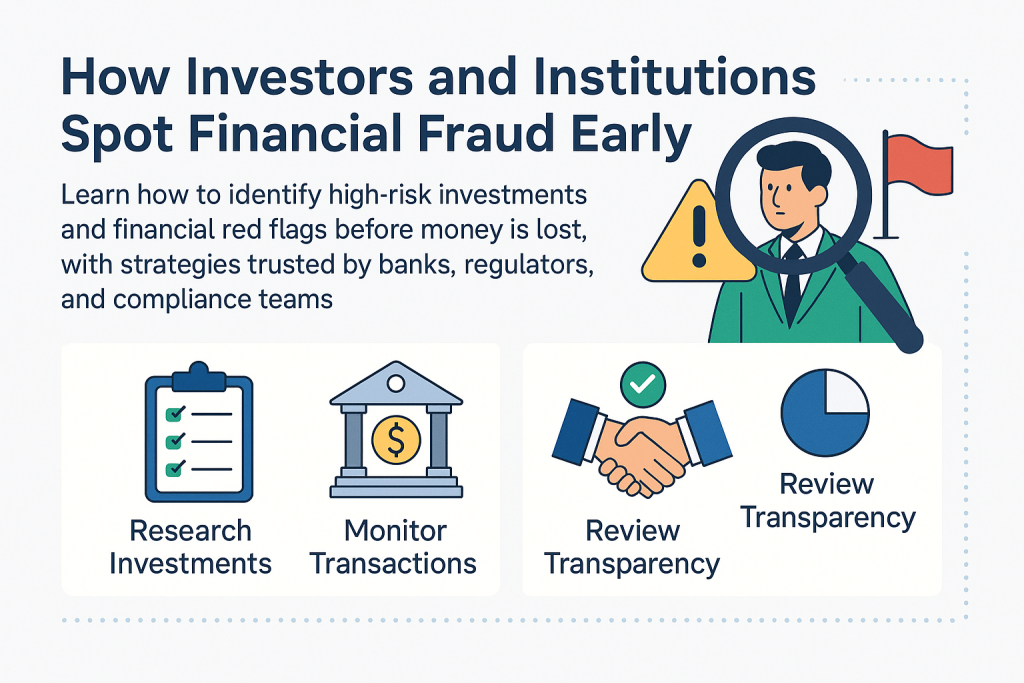
Financial fraud grows when trust is high and verification is weak. Many of the biggest financial crimes in history were not complicated structures. They were simple deceptions wrapped in confidence, polished marketing, and a sense of urgency. Investors believed the promise of stability and high returns. Institutions overlooked early warning signs. Communities endorsed opportunities without checking the foundation. When reality surfaced, fortunes disappeared and lives were permanently changed.
Spotting fraud early protects both individuals and financial institutions. The strongest defense is not a single technology or checklist. It is a mindset built on research, skepticism, and awareness of common deception patterns. Modern fraud schemes mix old tactics with new digital tools, but the signals they leave behind remain surprisingly consistent.
Understanding why fraud works and how to identify it gives investors and compliance teams a powerful advantage. A good example is the classic Ponzi structure, where operators use new deposits to manufacture the illusion of returns. Anyone who wants a deeper breakdown can review Flagright’s guide on understanding Ponzi mechanics, which explains how these schemes grow and eventually collapse:
https://www.flagright.com/post/understanding-the-mechanics-of-ponzi-schemes
The same principles that expose Ponzi schemes also help uncover modern financial threats across digital assets, investment networks, payment apps, and cross border money flow. When the signs appear early, losses can be prevented rather than repaired.
Why Smart People Still Fall for Financial Fraud
Fraud is not a problem limited to inexperienced investors. History shows that educated, wealthy, and well connected people have also been victims. Fraudsters succeed because they understand human behavior more than financial markets.
Why scams work
Emotion beats logic. Urgency, exclusivity, and fear of missing out pressure people into acting quickly.
Social proof lowers skepticism. Seeing friends or respected figures invest makes risk feel smaller.
Complexity creates false credibility. Fraudsters use confusing language to mask simple lies.
Greed dulls caution. High promised returns weaken instincts that normally prevent risky decisions.
Secrecy is framed as strategy. Operators claim disclosure would “hurt performance” to prevent questions.
Recognizing this psychology is as important as recognizing suspicious transactions.
Key Red Flags That Signal Investment Risk
Fraud always produces warning signs before it collapses. Some are obvious. Others are subtle but appear consistently across schemes.
Signs individual investors should watch for
- Returns that never fluctuate
- Pressure to reinvest instead of withdraw
- Vague or inconsistent explanation of the business model
- Missing audited financial statements
- Delayed or restricted withdrawals
- Reliance on testimonials instead of verifiable results
- Secrecy around partners, strategy, or revenue sources
Signs monitored by banks and fintechs
- Large inbound transfers from unrelated individuals
- Activity inconsistent with customer profile
- Growth without legitimate commercial activity
- Repeated circular transfers across connected accounts
- Attempts to bypass onboarding or risk checks
- Heavy use of payment processors with no clear purpose
When several of these signals align, risk increases sharply.
How Financial Institutions Detect Fraud Earlier Today
Modern institutions rely on technology capable of reviewing behavior across accounts, regions, and channels in real time. Fraud moves too fast for manual review alone. By the time traditional teams identify a suspicious pattern, funds may already be distributed across multiple countries.
Advanced monitoring helps institutions:
- Detect abnormal transaction patterns
- Map relationships between accounts and devices
- Identify coordinated activity across large groups
- Build behavioral profiles instead of relying only on rules
- Generate investigations supported by strong evidence
Many institutions strengthen their programs by adopting modern financial crime compliance solutions like those at https://www.flagright.com/ which unify customer risk evaluation, transaction monitoring, sanctions screening, and case investigation. Integrated systems reduce false positives, accelerate detection, and expose coordinated activity long before losses multiply.
Why Manual Monitoring Fails Against Modern Fraud
Relying solely on analysts puts institutions at a disadvantage.
Common limitations include:
- High false positives that drain time
- Delayed investigations that allow funds to escape
- Fragmented datasets that hide patterns
- Slow reporting that weakens regulatory response
Fraud networks adjust faster than human review cycles. Prevention demands tools that learn continuously and detect anomalies as they form.
The Scale of Financial Fraud Today
Recent data highlights why early detection matters:
- The United Nations estimates that 2 to 5 percent of global GDP is laundered each year, equal to hundreds of billions of dollars.
- The FBI logged more than 12.5 billion dollars in internet related fraud losses in 2023.
- More than 110,000 victims were affected by investment scams in the same year.
Fraud targets trust. It targets vulnerability. It targets the belief that financial opportunity can arrive without risk.
Investor Education: The First Line of Protection
Awareness remains one of the most effective fraud prevention tools. Before investing, individuals and institutions should take simple defensive steps.
Smart habits include:
- Confirming registration with financial authorities
- Requesting audited financial statements
- Verifying leadership identities and backgrounds
- Understanding the true basis of projected returns
- Testing withdrawals early
- Comparing claims against real market conditions
- Consulting independent professionals
If answers feel evasive or overly complicated, risk is likely present.
Compliance Collaboration: The Future of Fraud Prevention
Fighting financial fraud requires coordination. Regulators, banks, fintech companies, technology partners, and law enforcement all play roles in sharing information and strengthening controls. Modern platforms that unify monitoring, automated reporting, and customer risk scoring allow institutions to detect criminal activity far earlier than before.
Technology accelerates detection. Collaboration gives it the power to scale.
A Smarter Path Forward
Stopping fraud protects far more than financial capital. It protects families, communities, and long term economic stability. Investors protect themselves by asking questions others avoid. Institutions protect their customers by prioritizing visibility, accuracy, and real time detection.
Fraud grows in silence. Transparency disrupts it.
Strength begins with vigilance, knowledge, and the ability to recognize risk before it becomes loss.